
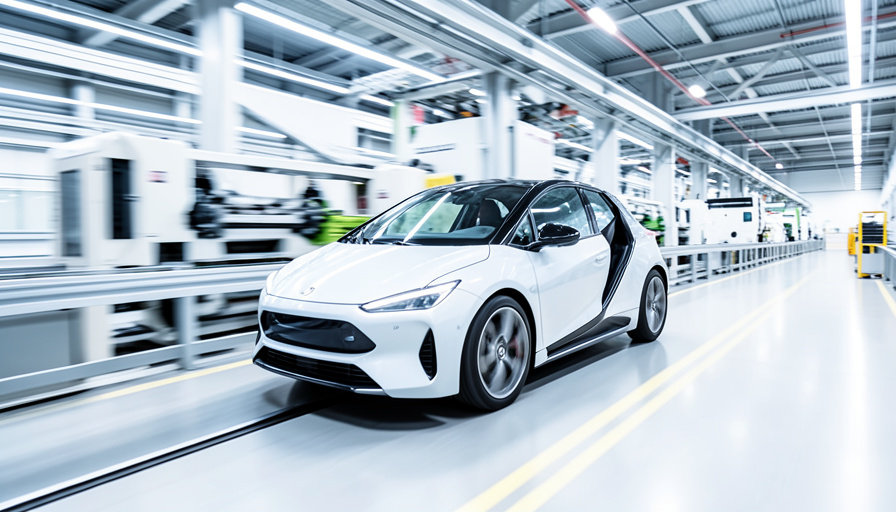
Can Tesla Really Build a Cybercab Every 10 Seconds?
Tesla says the Cybercab line can turn out a car every 10 seconds. That number needs unpacking before you believe it or dismiss it.
The most repeated figure from Tesla’s Cybercab push was not the price or the range. It was 10 seconds, the gap between one finished car and the next. Some people heard a manufacturing breakthrough. Others heard another Musk promise destined to slip. The reality sits in between, and it starts with what “10 seconds” even measures.
Bottom Line First
Tesla says its unboxed Cybercab line can eventually produce one car every 10 seconds, with a long-term goal of five, against roughly 34 seconds for a Model Y. That figure is a cycle time, the pace at full speed, not the time to build a single car from scratch. It is also a target, not today’s output: Musk himself has called early production “agonizingly slow.” Given Tesla’s record on timelines, the claim is worth taking seriously and checking against real production rather than launch slides.
Table of Contents
What Tesla Is Actually Claiming
The stated target is a cycle time under 10 seconds, with a stretch goal of about five. Tesla frames that against roughly 34 seconds for a Model Y coming off a conventional line, which would make the Cybercab line several times faster at full rate. Musk has said the Cybercab is built more like “a high-volume consumer electronics device than a car manufacturing line,” and the numbers reflect that ambition, as summaries of the target confirm.
What “One Every 10 Seconds” Really Means
Here is the misunderstanding worth clearing up first. A 10-second cycle time does not mean a car is assembled from raw parts in 10 seconds. It means that once the line is running at full speed, a finished car rolls off the end every 10 seconds. Any individual car still spends hours moving through the modules.
Think of it like a bakery. Bread takes an hour to bake, but if the oven is full and staggered, a fresh loaf comes out every minute. Cycle time is that “every minute” figure. It sets the factory’s top speed and, with it, the cost per car, which is the real reason Tesla cares about the number.
Why the Skeptics Have a Point
The caution goes beyond reflexive Musk-bashing. The strongest skeptic in this story is Musk himself. He has warned that early Cybercab production will be “agonizingly slow” because “almost everything is new,” following the usual S-curve before it becomes fast, per his own comments after the 10-second claim.
Layer on Tesla’s history. Model 3 “production hell,” a Cybertruck that arrived late and in smaller numbers than promised, and repeated robotaxi timelines that moved. The pattern is not that the goals are fake. It is that they tend to arrive later and lower than the launch-day version. So the honest read is to treat 10 seconds as a destination, not a description of the line running today.
What Would Actually Prove It
Ignore the launch slides and watch one thing: sustained output. A single car built fast during a demo proves nothing. The claim only holds if Giga Texas is turning out Cybercabs at a steep, rising weekly rate a year from now. Cycle time at full ramp, reflected in real production totals, is the only number that settles this, and it will show up quietly in quarterly figures long before any keynote mentions it.
At a Glance
- Tesla targets a Cybercab cycle time under 10 seconds, with a long-term goal near 5, versus about 34 for a Model Y.
- Cycle time is how often a car rolls off at full speed, not how long one takes to build.
- Musk has said early production will be “agonizingly slow” before it accelerates.
- Tesla’s history of late, smaller-than-promised ramps is the main reason for caution.
- The real test is sustained weekly output, not launch demonstrations.
For more on cars and EV technology, browse the DelightfulBlogs Automotive section, or read related coverage in our Tech section.
Frequently Asked Questions
Can Tesla really make a Cybercab every 10 seconds?
That is Tesla’s target cycle time at full speed, not its current rate. Whether the line reaches it depends on a production ramp that Musk himself expects to be slow at first.
Does 10 seconds mean a car is built in 10 seconds?
No. It means a finished car exits the line every 10 seconds once it is running at full speed. Each individual car still takes hours to move through assembly.
How does that compare to other cars?
Tesla cites roughly 34 seconds of cycle time for a Model Y on a conventional line, so a sub-10-second Cybercab line would be several times faster at full output.
Why are experts skeptical?
Tesla has a track record of missing or delaying ambitious targets, from Model 3 to Cybertruck. Musk has also cautioned that early Cybercab production will be very slow before it speeds up.
When will we know if the claim holds?
Watch sustained production totals over the coming quarters. Consistent, rising weekly output is the only evidence that the cycle-time claim has translated into real manufacturing.
The Bottom Line
The 10-second Cybercab is a genuinely bold manufacturing goal, and it is also exactly the kind of number that gets quoted long before it is achieved. Understanding that it means cycle time, not build time, cuts through half the hype and half the mockery at once. The rest comes down to execution, and on that Tesla has earned both its ambition and its skeptics. The scoreboard will be the production report, not the pitch.