
How Tesla’s ‘Unboxed’ Cybercab Assembly Actually Works
To see why Tesla thinks it can build a car in seconds, you have to look at how the Cybercab is actually put together. The trick starts with the paint shop.
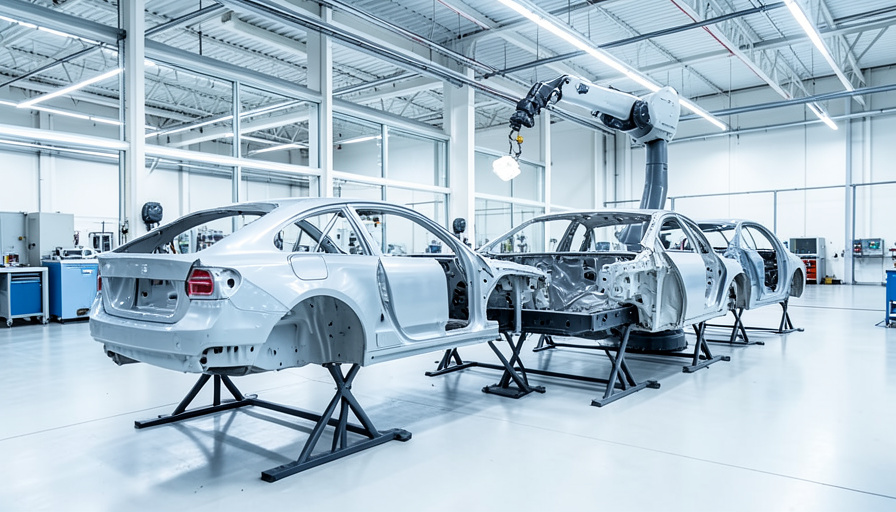
Most factory tours look the same. A bare car body climbs onto a line and slowly becomes a finished car as it crawls past hundreds of stations. Tesla’s Cybercab is built almost inside out. Instead of one body moving through one line, the car is broken into a handful of modules built at the same time, then joined at the end. The biggest change is the one nobody expects: the paint shop mostly disappears.
The Short Version
Tesla’s unboxed process splits the Cybercab into five or six large modules, the front, the rear, the sides, and a structural battery-and-floor unit, each built on its own sub-assembly line. Each module is painted separately before the car is assembled, which removes the traditional full-body paint shop that is normally the slowest and most expensive part of a factory. The modules then meet and get framed into a whole car in one late step. Tesla says the approach can cut costs by up to half and shrink the factory footprint by around 40%.
Table of Contents
From One Long Line to Five Modules
A conventional factory treats the car as a single object from the first weld. The body shell is built, then dragged through paint, then crawls through general assembly picking up parts. Everything happens in sequence, so the whole plant moves at the speed of its slowest station.
Unboxed refuses that. Tesla splits the vehicle into five or six big modules and builds each on its own line at the same time. Only near the end do the finished modules come together and get framed into one car, a structure Tesla laid out in a manufacturing patent. Parallel beats sequential, because five modules built at once take roughly the time of the single slowest module, not the sum of every step.
The Real Trick Is Painting Before Assembly
Here is the part that actually matters, and it is easy to skip past. In a normal factory, the paint shop is the villain of the whole operation. It is enormous, it is the most expensive building on site, and a full car body has to move through it slowly as one giant piece.
The unboxed process paints each module separately, before final assembly, so there is no need to send a whole assembled body through a full-scale paint shop at all. Removing that bottleneck is where a big chunk of the claimed cost and space savings comes from, up to 50% cost and a 40% smaller footprint by Tesla’s numbers, as design outlet Core77 detailed. Change when you paint, and you change the shape of the entire factory.
Why Open Modules Are Easier to Build
There is a quieter benefit hiding in the word “unboxed.” A traditional car near the end of the line is basically a closed box, and workers and robots have to reach in through door openings to fit wiring, seats, and trim. It is slow, awkward, and hard to automate well.
A module is open. A side panel on its own stand, or a floor unit before the walls go up, can be worked on from every angle. That makes the fiddly jobs faster and far friendlier to robots, which do their best work when they can approach a part cleanly. Multiply that ease across every module built in parallel and the time savings compound.
The Tradeoffs Tesla Is Betting On
None of this is free. Retooling a factory around unboxed assembly takes heavy upfront capital, because the whole plant layout is different from a standard line. And the approach is happiest building one design. Each module line is tuned to a specific set of shapes, so running several different models through the same unboxed plant is much harder than on a flexible traditional line.
That constraint is exactly why the Cybercab goes first. It is a single, simple, high-volume model with no legacy variants to accommodate, which makes it the cleanest possible test of the idea. The open question is quality at the final join, since framing separately built and separately painted modules into one tight, rattle-free car is a genuinely new engineering problem.
What Matters Most
- Unboxed splits the Cybercab into five or six modules built in parallel, not one body on a long line.
- Each module is painted before assembly, which removes the traditional full-body paint shop.
- Tesla credits that shift for up to 50% lower cost and a roughly 40% smaller factory.
- Open modules are easier for workers and robots to build than a nearly closed car.
- The tradeoffs are high retooling cost and difficulty building multiple models, which is why a single model like the Cybercab went first.
For more on cars and EV technology, browse the DelightfulBlogs Automotive section, or read related coverage in our Tech section.
Frequently Asked Questions
How does Tesla’s unboxed process work?
It builds a car as five or six large modules on separate sub-assembly lines at the same time, then joins and frames them into a finished vehicle in one step near the end, rather than moving a single body down a long sequential line.
What is different about painting in the unboxed process?
Each module is painted separately before final assembly, so there is no need for a traditional full-body paint shop. That is significant because the paint shop is normally the slowest and most capital-intensive part of a car factory.
How many modules make up a Cybercab?
Tesla describes roughly five or six major modules, including the front, rear, sides, and a structural unit that combines the battery pack and floor.
Why is the Cybercab the first unboxed vehicle?
It is a single, simple, high-volume model with no older variants to support, which makes it the cleanest case for a process that is hardest to run across multiple different models.
What are the downsides of unboxed manufacturing?
It requires large upfront investment to retool a plant, it is difficult to use for several models at once, and joining separately built modules into one tight car raises new quality-control challenges.
Practical Takeaway
The clever part of the Cybercab is not the marketing number of 10 seconds a car. It is the decision to stop treating a car as one object all the way down the line. By painting and building in pieces and joining them late, Tesla is attacking the paint shop and the closed-box problem at the same time. Whether the finished cars hold together as well as ones built the old way is the test that matters, and it is one only volume production can settle.